New Page for Holiday Recipes!

I just wanted to add a quick post announcing a whole page here on Gram’s Recipe Box dedicated to vintage and heirloom holiday recipes! I am excited about this because there are certain foods that to me announce the arrival of the winter holidays and populate the plates during the many family get togethers and cocktail parties to be expected from November through January. While there are certainly many more holiday dishes than can be imagined, I wanted to have some of the main stays all on one page, making it easier for YOU to find what you might be looking for. Whether it is a recipe or six for fruit cake, three different cranberry sauces, or a menu for your next casual party, click the link above my avatar that says “Vintage Holiday Recipes” to access the new page. There you will find links to some of our most popular recipes and posts.

As always, thanks for visiting Gram’s Recipe Box! I do this for you, so if there is ever a comment or question that you want answered, please let me know!


Fried Fish

Item number 4 from Maggie Ritchie’s book is a recipe for Fried Fish. I can’t quite make out one of those first words, which is the name of a fish. If you have an idea, just make a comment.

Fried Fish

Take a plaice (?) or a haddock fillet it. Well wash it, dry it & dip each piece into a little flour. Have a well beaten egg. Dip small pieces of the fish into this, then toss them into oatmeal or bread crumbs. Have a saucepan of fat on the fire quite hot. Dip the fish into this and fry it for a few minutes. 2 1/2 to 3 minutes is long enough. The tests when the fat is hot enough, are that a blue steam arises from it & it is quite still. Remember when you take it up always strain it, on a piece of blotting paper. This mode of frying is called wet frying.

Bread Sauce

This recipe seems to be out of context as it refers to milk that was “put in with the rabbit” but there is not a rabbit recipe yet. If this was for a class, perhaps the students learned all the recipes and then created their own cookbook as their final project? It makes some sense to me. The bread sauce appears to be like a gravy.

Bread Sauce

Put into a clean saucepan 1 pint milk, taking the milk that was put in with the rabbit for 20 min. Throw into this an onion & let it stand by the side of the fire for about 10 minutes. Take out the onion & shake in as many bread crumbs as will thicken it. Add a pinch salt & a grate or two of nutmeg.

Corn Flour Shape

I have eaten “corn flour shape.” It is bland, but it can be spruced up with a topping such as fruit, as suggested in this recipe. It’s also gluten free for those who need an interesting dessert that will work with a GF diet. When she says to pour this into a shape, she means a jello mold. I have read that the number of jello molds a kitchen had spoke to the wealth of the household because it was very difficult to keep jello cold, and they did not want to waste food. Secondly, you probably would use vanilla extract here for the flavoring. This is similar to corn starch pudding and I wonder if it really is just a chilled pudding in a mold.

Corn Flour Shape

Put into a saucepan 2 breakfast cupful milk & allow it to boil. Break in a basin with a little cold milk 2 tablespoonful corn flour 1 tablespoonful sugar, a few drops flavouring. When the milk boils pour it on to the corn flour stir thoroughly & return it to the saucepan & cook for 5 minutes. Dip a shape into cold water, pour the corn flour into it & set it aside to get quite cold. Then turn it on to a glass dish & serve with either jelly or stewed fruit, such as apples, pears, etc.


Thanks to Maggie S. Ritchey

I’ve been slacking off posts because of an overwhelming amount of source material. I realize that doesn’t make sense, but “overwhelming” is the key word in that sentence. Recently, I have collected well into the hundreds of vintage and heirloom handwritten recipes! I found a little box very similar to my Gram’s recipe box (the one that started this whole thing!) at a local antique shop and lo and behold it was packed to the gills with recipes! Then, I found an old notebook, every page filled with handwritten recipes and then a few pages having cuttings glued in. On ebay I found a packet of 35 handwritten recipe cards, and a fabulous old book from the 20s that is just falling to pieces, but has wonderful heirloom recipes, menus and entertaining notes written on nearly every page. My final treasure is a 19th century pamphlet, handwritten by Ms. Maggie S. Ritchey, Class V Senior, from Edinburgh, Scotland. It was tough to decide where to start, and that fueled my hemming and hawing.

Finally I decided to begin at the beginning, so to speak, and work with the oldest set of recipes. I believe the booklet might be from an home economics or basic cooking course for girls. There is an index in the back and each page is numbered. The variety of dishes range from soup to basic dinner entrees to desserts, with 30 recipes over 42 pages. The handwriting is graceful and oh so nostalgic. I will present this book to you in the order it is written, so without further delay we have item number one: short bread.
Short bread

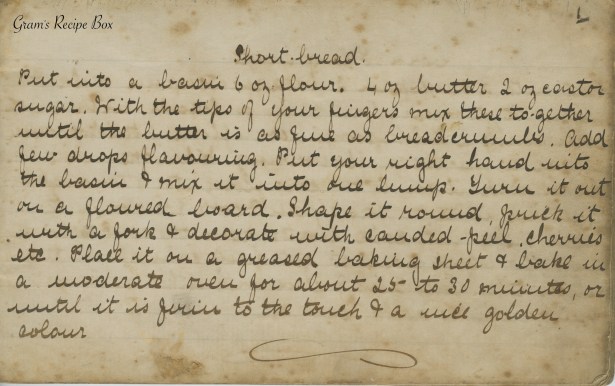
Put into a basin 6 oz flour, 4 oz butter 2 oz castor* sugar. With the tips of your fingers mix these together until the butter is as fine as breadcrumbs. Add few drops flavouring. Put your right hand into the basin & mix it into one lump. Turn it out on a floured board. Shape it round, prick it with a fork & decorate with candied peel, cherries etc. Place it on a greased baking sheet & bake in a moderate oven for about 25 to 30 minutes, or until it is firm to the touch & a nice golden colour.

* castor sugar is white granulated sugar that has been ground again so it is more fine than standard white granulated sugar. It is not as fine as powdered sugar.