Curry

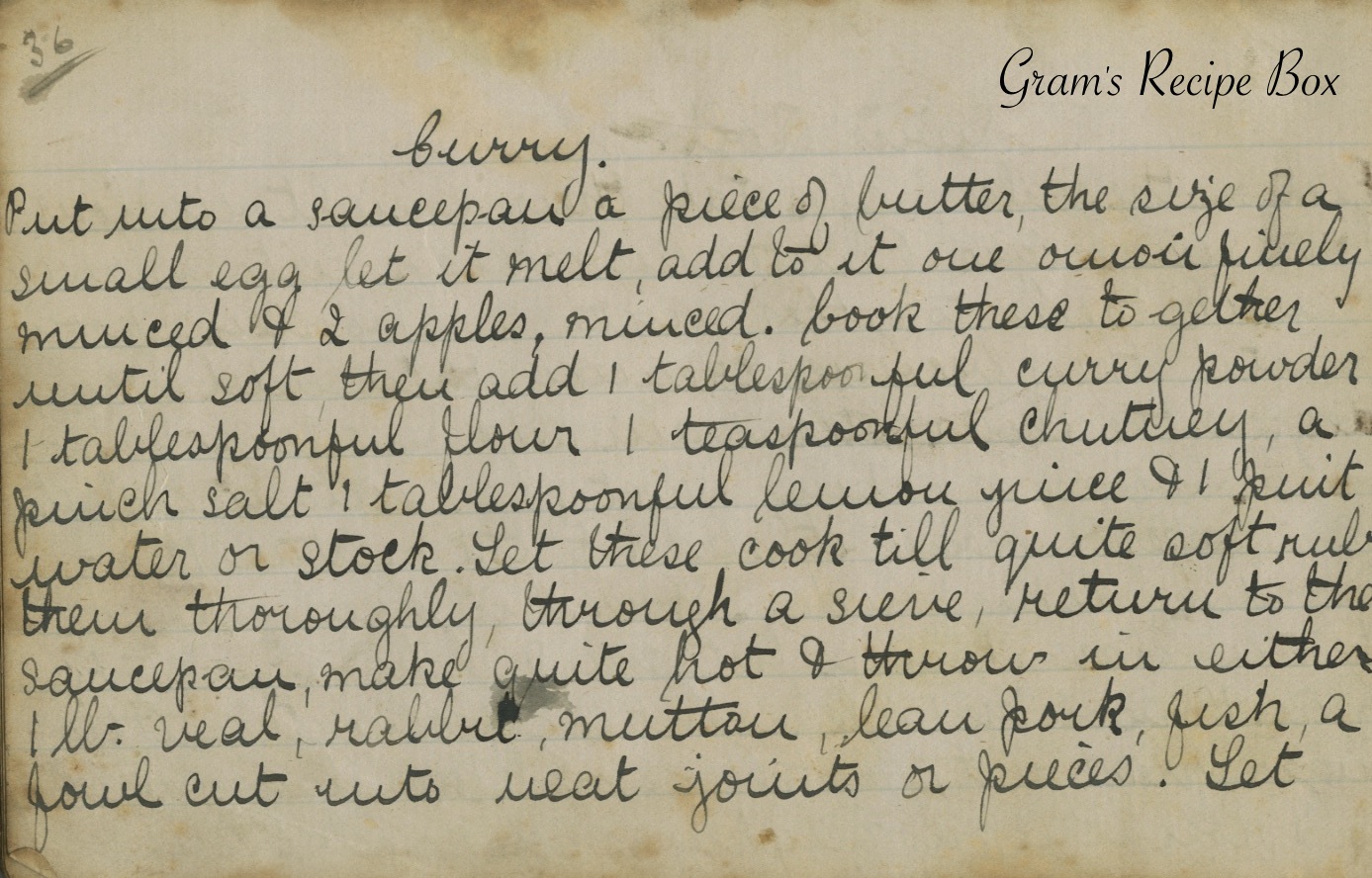
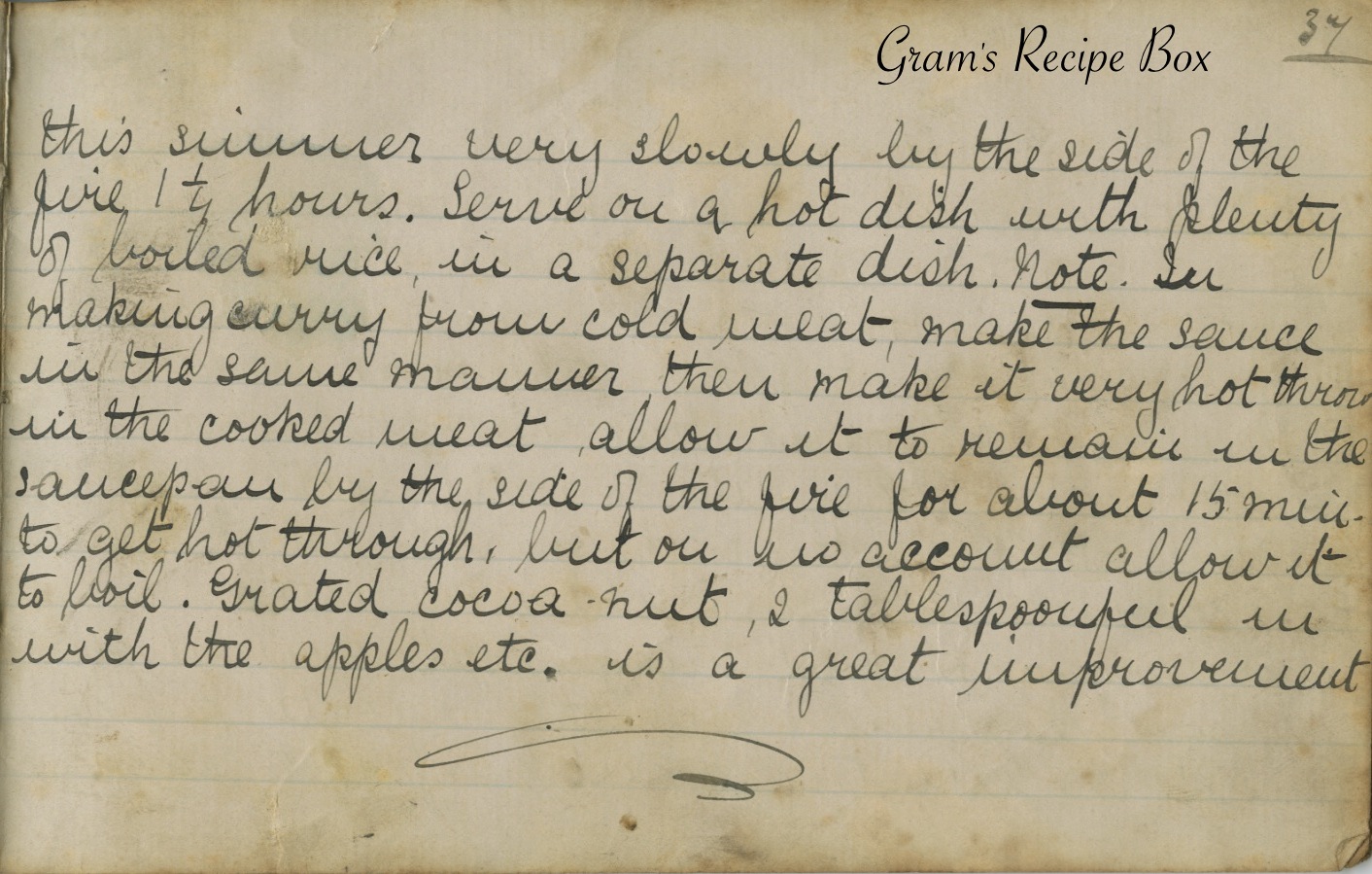
This recipe for curry calls for chutney as one of the ingredients. These days we tend to think of chutney as a preserve or sweet condiment, but historically chutney can vary in sweetness, texture, ingredients and level of spice. Chutney comes from India and Pakistan, and can be vastly different from one side of the region to the other. In the 19th century – while India was still a British colony – certain sweeter chutneys were exported back to England, and this is probably what Maggie Ritchey was familiar with. They were mainly made with fruit, vinegar and sugar, boiled down to a reduction. Depending on the type of chutney available to you, it could kick up the spice on this dish, so be careful.

Curry

Put into a saucepan a piece of butter the size of a small egg, let it melt, add to it one onion finely minced & 2 apples minced. Cook these together until soft, then add 1 tablespoonful curry powder, 1 tablespoonful flour, 1 teaspoonful chutney, pinch salt, 1 tablespoonful lemon juice, & 1 pint water or stock. Let these cook til quite soft, rub them thoroughly through a sieve, return to the saucepan, make quite hot & throw in either 1 lb veal, rabbit, mutton, lean pork fish, or fowl cut up in neat joints or pieces. Let this simmer very slowly by the side of the fire 1 1/4 hours. Serve on a hot dish with plenty of boiled rice in a separate dish. Note. In making curry from cold meat, make the sauce in the same manner, then make it very hot, throw in the cooked meat, allow it to remain in the saucepan by the side of the fire for about 15 min to get hot through, but on no account allow it to boil. Crated cocoa nut, 2 tablespoonful in with the apples etc. is a great improvement.

Swiss Roll

This recipe is for a jelly roll. I have one from my grandmother with similar instructions but with the measurements, which is very helpful! Again, the kitchen Maggie Ritchey was cooking for must have been quite different from even mid 20th century kitchens because she used weights rather than volume measurements. I have read recently that in baking especially, weights are more precise and so could possibly give a better outcome. I am not convinced, but I also think that as a home baker for my family and friends, the outcome is not as crucial as a head cook in the kitchen of a great house or restaurant.

Below the transcription of Maggie’s recipe, for comparisons sake I will add the more modern jelly roll recipe. Gramma A says that Gram had an electric mixer pretty soon after they were available, so even if this recipe is from the 1930s the mixer could still have been used. The first electric hand mixer was available to homemakers in the 1910s. Who knew?

Swiss Roll

Put on the scales 3 eggs take their weight in flour & in fine sugar. Put the sugar & eggs into a basin & work them to-gether with a wooden spoon until they become creamy, then add by degrees the flour. Stir again, add few drops flavouring. Grease a baking sheet, lay into it a sheet of paper & grease it. Add to the mixture 1 teaspoonful baking powder. Spread it evenly all over the tin, place it in a hot oven & bake from 7 to 12 min. Have on the table a sheet of paper with a little sugar spread on it, turn the roll on to this & lay some jam in & roll it up as quickly as you possibly can.

*****

Jelly Roll (Mother)

Liberally butter cookie sheet with lip and flour

Sift together and set aside until needed:

1 cup flour

1 teaspoon baking powder

Have 1 tablespoon melter butter ready

1/4 teaspoon salt

Beat 4 eggs until very thick and light. Gradually add 3/4 cup sugar, beating all the while – add 1 teaspoon vanilla. Remove beaters and fold in flour mixture carefully. Just before putting into pan, add melted butter – don’t stir too well. Bake at 400 for 15-20 minutes. While baking lay out linen dish towel sprinkled with powdered sugar and get ready a jar of dark jelly by beating it with a fork. Turn out cake onto cloth – quickly make cuts along edge of cake so it will roll. Spread with jelly, roll up and wrap in cloth until it remains in shape.

Boiling of Green Vegetables

I never really thought I’d need instructions on how to boil green vegetables, and honestly I think it rather funny that Maggie’s example is a cauliflower – which is not green at all! However, her notes do say that these instructions apply to all green vegetables except spinach. I find the addition of washing soda to the food somewhat off-putting. However, washing soda is relatively similar to baking soda and you could use that instead. Washing soda is more alkaline and thereby more caustic in large quantities. I think I would just use water to boil my veggies.

Boiling of Green Vegetables

Take a cauliflower, thoroughly wash it & free it from all clay & dirt, if possible let it be in cold water for at least 1/2 hour. On no account put salt in the water that it is steeping in. Have a saucepan of boiling water on the fire, add to it a good pinch salt & a tiny bit washing soda the size of a pea. Place the cauliflower into it with the flower down & boil it without a lid, from 15-20 min. Take it up, cut the coarse stalk from it, place it in a hot vegetable dish & serve it with white sauce. Note This applies to the boiling of all green vegetables with the exception of spinach.

Lemon Jelly

Until this recipe, I have never heard of intentionally putting egg shells into something intended to be eaten, especially something like this. But don’t worry, it seems the brew is strained and the shells removed! One of my favorite parts of this recipe is the direction to put a chair on the table to use it in the straining process. Just how big were the kettles Maggie was using? Also, this is for a “jelly” meaning to Americans a jello dish. You will eventually pour the cooked gelatin into a mold and chill before turning it out.

Lemon Jelly

Put into a clean saucepan 1 oz packet gelatin. Pour on to this 1 pint & 1 gill of cold water, 1/4 lb loaf sugar, 1 inch stick cinnamon, the rind of 2 lemons peeled very thinly & the juice of two, about 10 cloves, the whites & shells of 2 eggs. Put the pan on the fire & with a whisk, beat it till a stiff white froth appears. Let it boil up twice. Draw the pan to the side of the fire & allow it to stand steadily of 15 minutes. Turn a chair up on a table & tie over it a tea cloth. Place a basin in the bottom of the chair, pour some boiling water through the cloth, take it away & replace a clean basin. Then carefully pour the jelly through. If not clear during the first pouring, pass it through again & again until it is quite clear. If you are wishing to put sherry or wine to the jelly do so when the jelly is nearly cold & before putting it into your mould which must always be well-wetted. Pour the water away & shake it out.

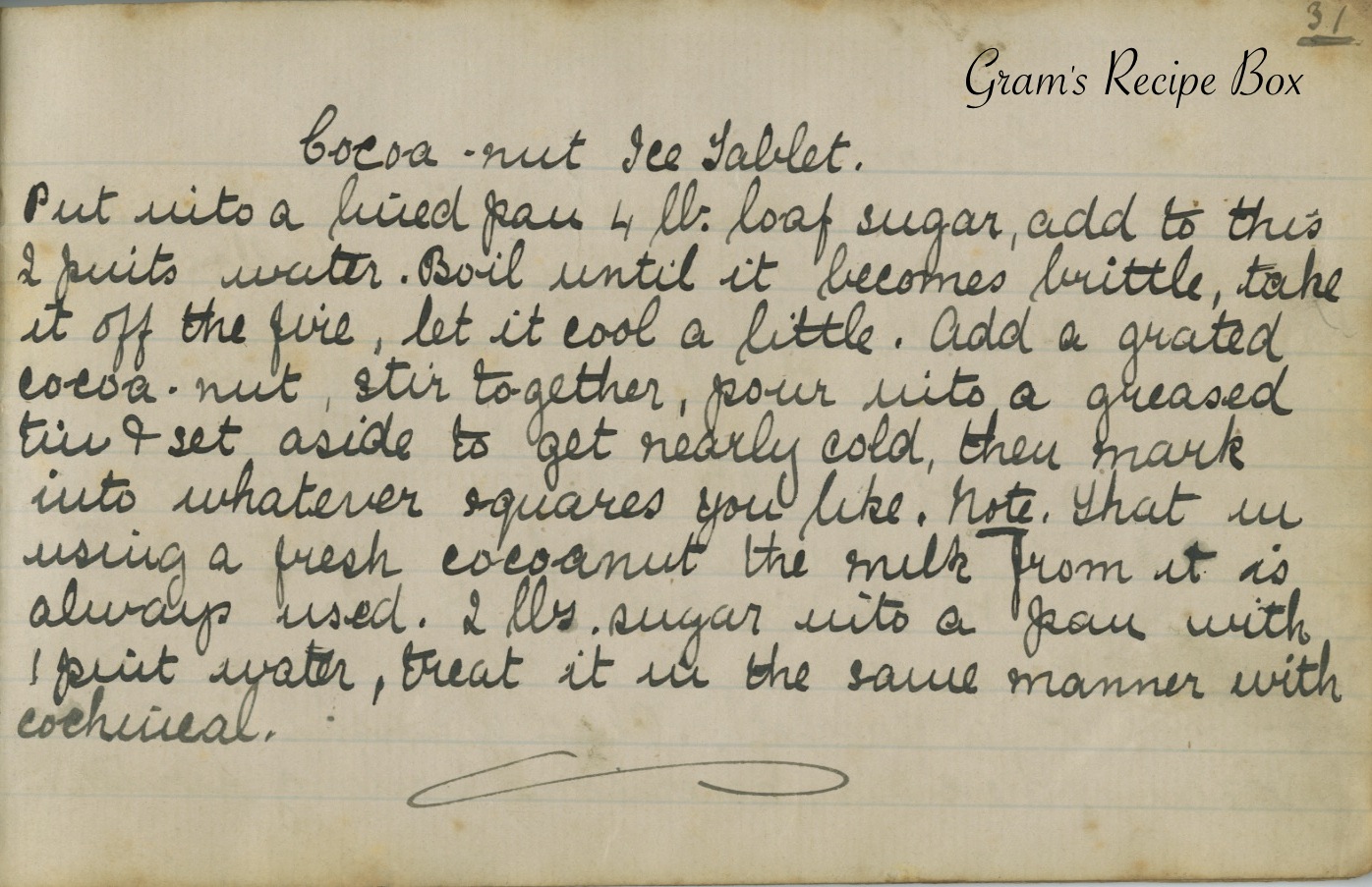
Cocoa-nut Ice Tablet

This recipe is for a coconut candy that appears to be quite easy. Of course, I have no idea what quantity of coconut you would need, but might it be fun to get a coconut and grate it just to find out? It’s a rather labor intensive process, even if it is pretty easy. I discovered a funny post over at another site detailing how to open the coconut and extract the meat inside. This blogger says her coconut yielded a sandwich baggie full, which might be around 1 1/2-2 cups.

A second thing about this recipe is curious to me. In the last sentence, that last word sure looks like cochineal to me. The cochineal is an insect used to derive red food coloring, but it doesn’t have any taste. So, I am not quite certain what that could be about…possibly the candy from a fresh coconut would be red?

Cocoa-nut Ice Tablet

Put into a lined pan 4 lb loaf sugar, add to this 2 pints water. Boil until it becomes brittle, take it off the fire, let it cool a little. Add a grated cocoa-nut, stir together, pour into a greased tin & set aside to get nearly cold, then mark into whatever squares you like. Note that in using a fresh cocoanut, the milk from it is always used. 2 lbs sugar into a pan with 1 pint water, treat it in the same manner with cochineal.