Pea soup

I am reminded of the old rhyme “Peas porridge hot, peas porridge cold, peas porridge in the pot nine days old!” I certainly hope this doesn’t last nine days, as it sounds quite good. We are big fans of pea soup in my house, so perhaps I will try this one.

Pea Soup

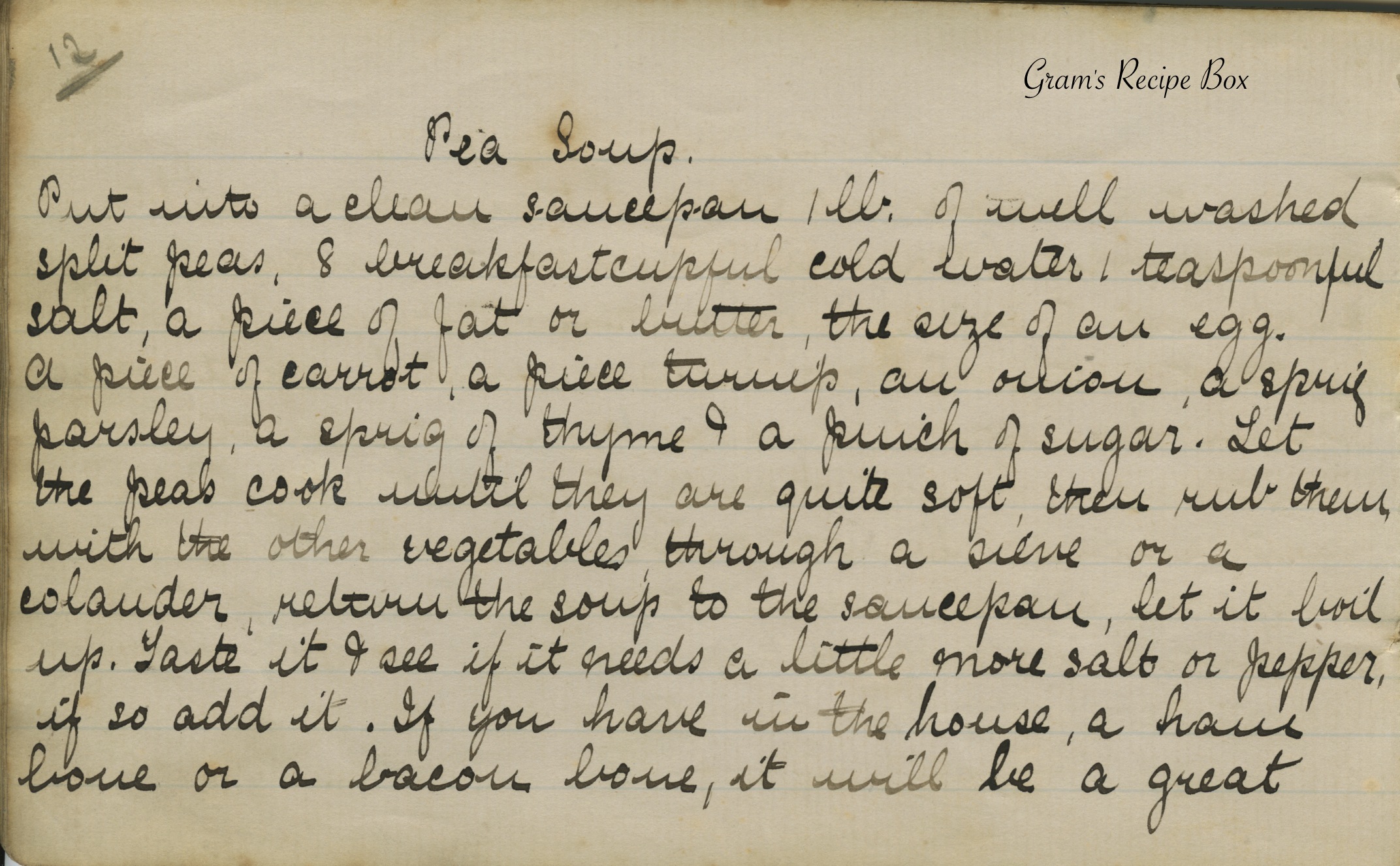
Put into a clean saucepan 1 lb of well washed split peas, 8 breakfastcupfull cold water, 1 teaspoon salt a piece of fat or butter the size of an egg, a piece of carrot, a piece of turnip, an onion, a sprig of parsley, a sprig of thyme & a pinch of sugar. Let the peas cook until they are quite soft, then rub them with the other vegetables through a sieve or a colander, return the soup to the saucepan, let it boil up. Taste it & see if it needs a little more salt or pepper, if so add it. If you have in the house, a ham bone or bacon bone, it will be a great improvement, to boil it with the soup. The fat or butter may then be omitted. Toast cut in dice & served on a plate is an improvement also, sometimes sweet herbs are crushed & served, separately with the soup.

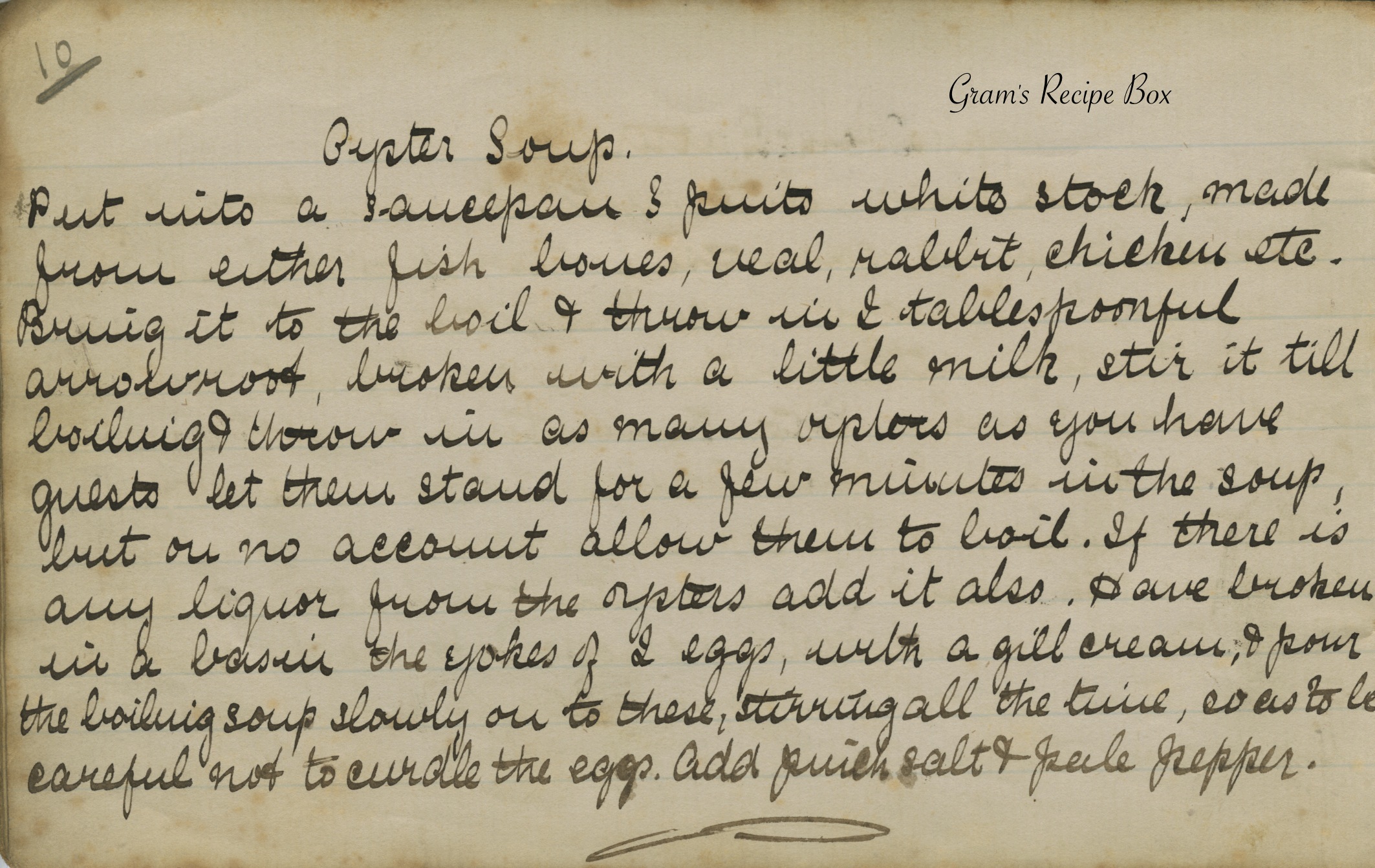
Oyster Soup

This recipe for oyster soup had me turning to the internet to research. Because this is at least 110 years old, some cooking terminology and ingredients have changed over the years. Right off the bat I must make it clear that the oysters are to be shelled prior to cooking. It might sound like common sense to many of us, but I would hate for there to be a “Bridget Jones” moment in someone’s future.

Secondly, arrowroot. This is a root commonly available in its powdered form. It is a tuber grown in the equatorial climates, and apparently was so used in British cuisine that Napoleon claimed it was Britain’s way of supporting its colonies. The powder you find in the store may or may not be pure arrowroot, so have care when making your selection. When combined with other starches such as potato starch the desired results may not be achieved. Arrowroot is used like corn starch or flour in sauces, as a thickening agent. In soups, it would add some thickness to broth without breaking down or becoming gritty or clumpy.

Next, “gill cream.” I was stumped at first because I was looking for the source of gill cream. However this refers to a measurement. A gill is 1/8 of a British pint, so use heavy cream or half & half, and of course, a British pint is larger than an American pint, so a gill in America is .6 cups, so slightly over 1/2 a cup.

Oyster Soup

Put into a saucepan 3 pints white stock, made from either fish bones, veal, rabbit, chicken, etc. Bring it to the boil & throw in 2 tablespoonful arrowroot broken with a little milk, stir it til boiling & throw in as many oysters as you have guests, and let them stand for a few minutes in the soup, but on no account allow them to boil. If there is any liquor from the oysters add it also. Have broken in a basin the yokes of 2 eggs, with a gill cream & pour the boiling soup slowly on to these, stirring all the time, so as to be careful not to curdle the eggs. Add pinch salt & pinch pepper.

Apples in Batter

My mouth is watering, how about yours? Apples in batter sounds  a lot like a cake of some kind and I bet it is delicious. Of course, I love apple desserts. I bet once this is baked you could top it with vanilla ice cream or whipped cream, and maybe some caramel sauce. Mmmmmmm.

* If you would like to read all of Maggie Ritchey”s recipes just click on her name in the “categories” drop down. *

Apples in Batter

Grease a pie dish, slice into it very thinly 3 apples. Sprinkle over these 2 tablespoonful sugar, a squeeze lemon juice & a little grated lemon rind. Make a batter with 3 oz flour, 1/2 pint milk. Drop very slowly into it, until a smooth batter. Drop in an egg & beat 5 min. Add pinch salt & pour over the apples, on the top lay a few pieces butter. Place in the oven & bake until teh batter is firm to the touch & a nice golden colour. If the apples are old or tough it is a good plan now & again while cooking to dip them down with a fork.

Rock Cakes

This recipe called Rock Cakes seems very similar to one that Gram had called Rocks and another I have called Nuggets. All of these recipes vary slightly from one another, but appear to produce a very similar cookie. I have not tried any of these yet, but I believe they would be a firm and not too sweet cookie, good with tea or coffee.

Rock Cakes

Put into a basin 1 lb flour, 1/4 lb butter, a pinch salt. Break the butter into the flour, in pieces the size of a pea. Add to this 1/4 lb sugar. Mix these well to-gether, add a teaspoonful baking powder, 1/2 teaspoon ground cinnamon, 1/4 lb cleaned currants, 1 oz candied peel minced finely, 2 eggs well beaten, with enough milk to make a stiff dough. Mix well to-gether with a fork. Drop some pieces on to a greased baking tin. Place in a quick oven & bake for about 20 minutes.

Roast Fowl

The next time you find yourself presented with a live chicken in payment for yard work, you will be able to reference Maggie Ritchey’s notes on how to deal with it once it is no longer living. It goes without saying that you will need to pluck it first.

Roast Fowl

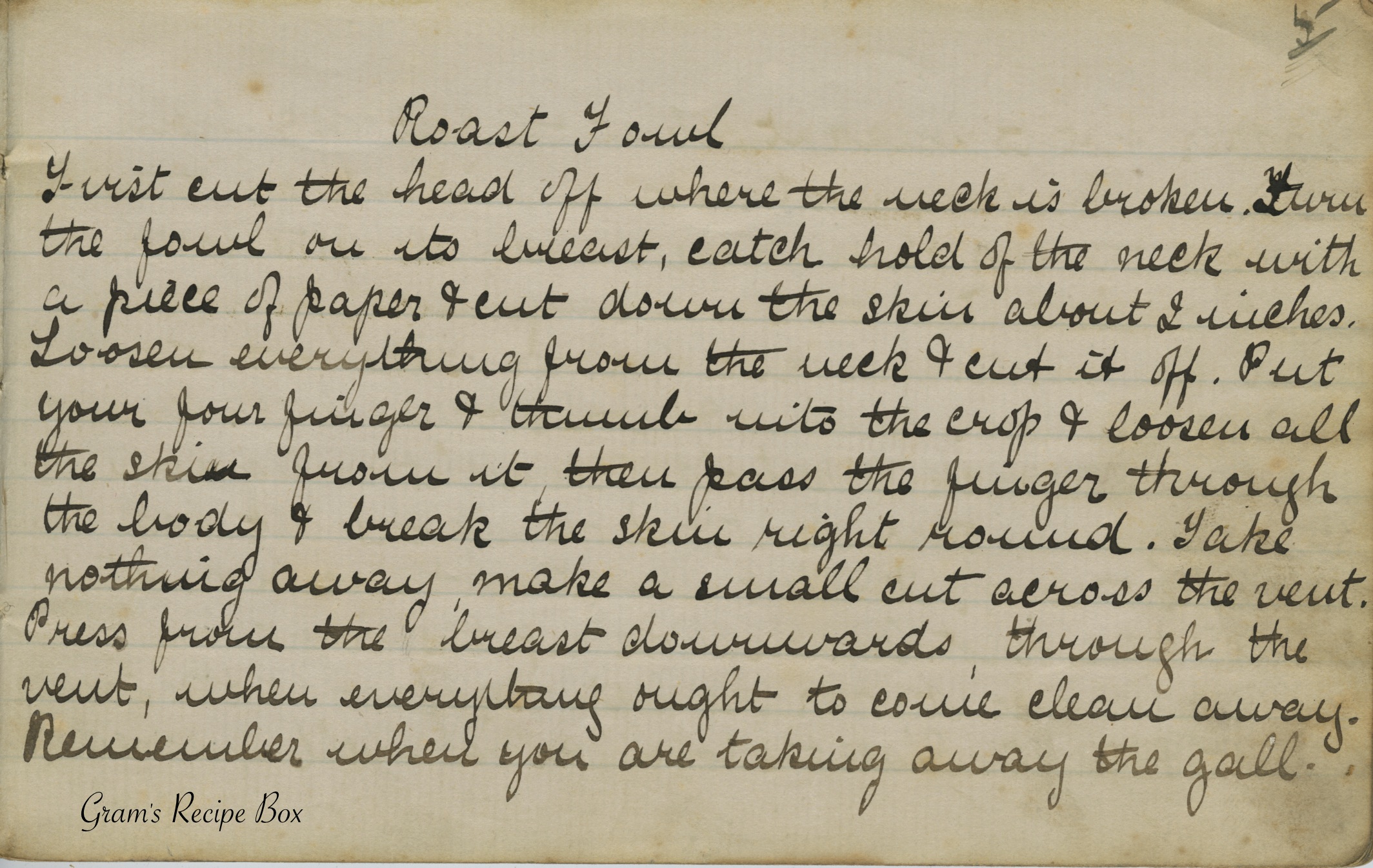
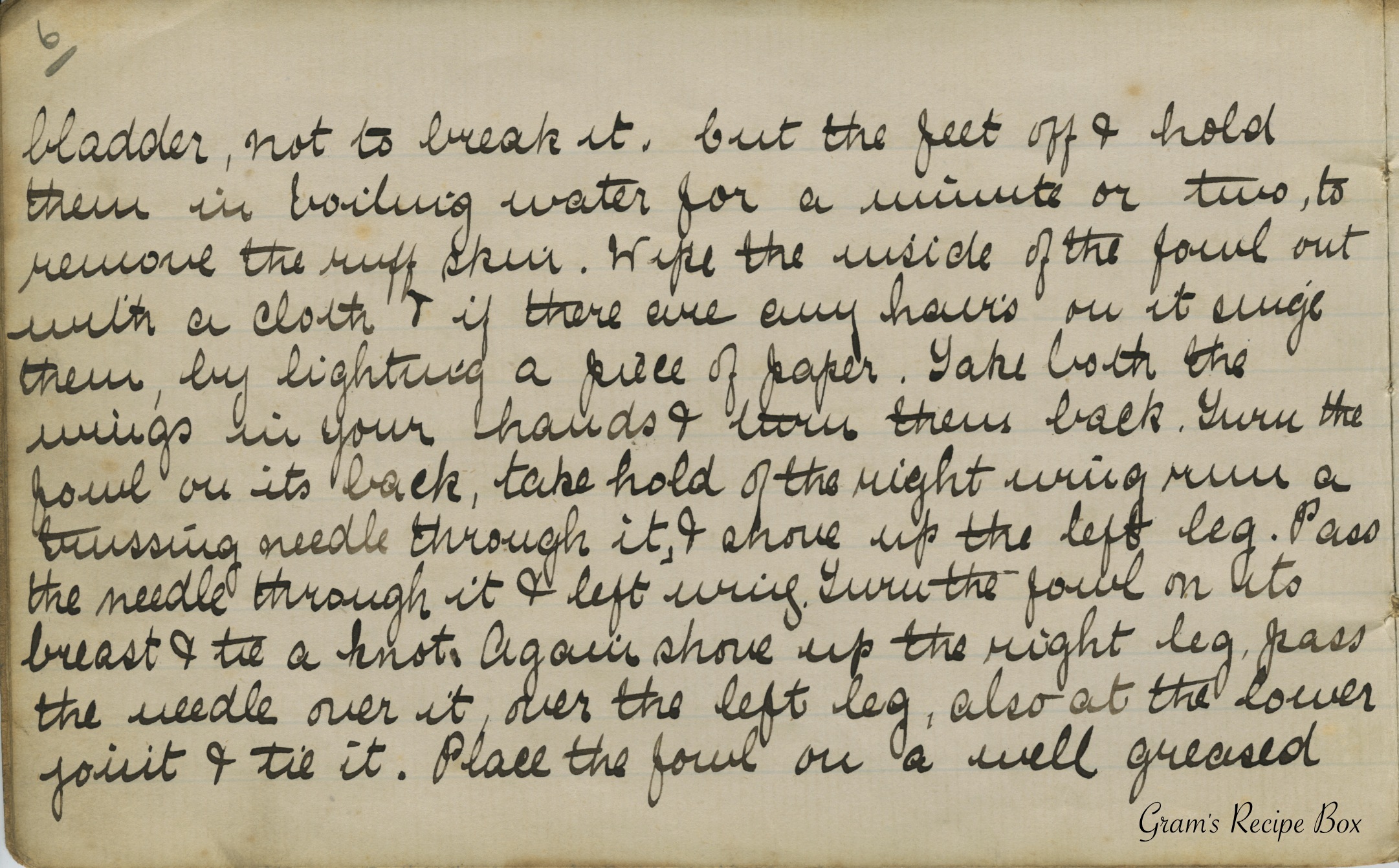
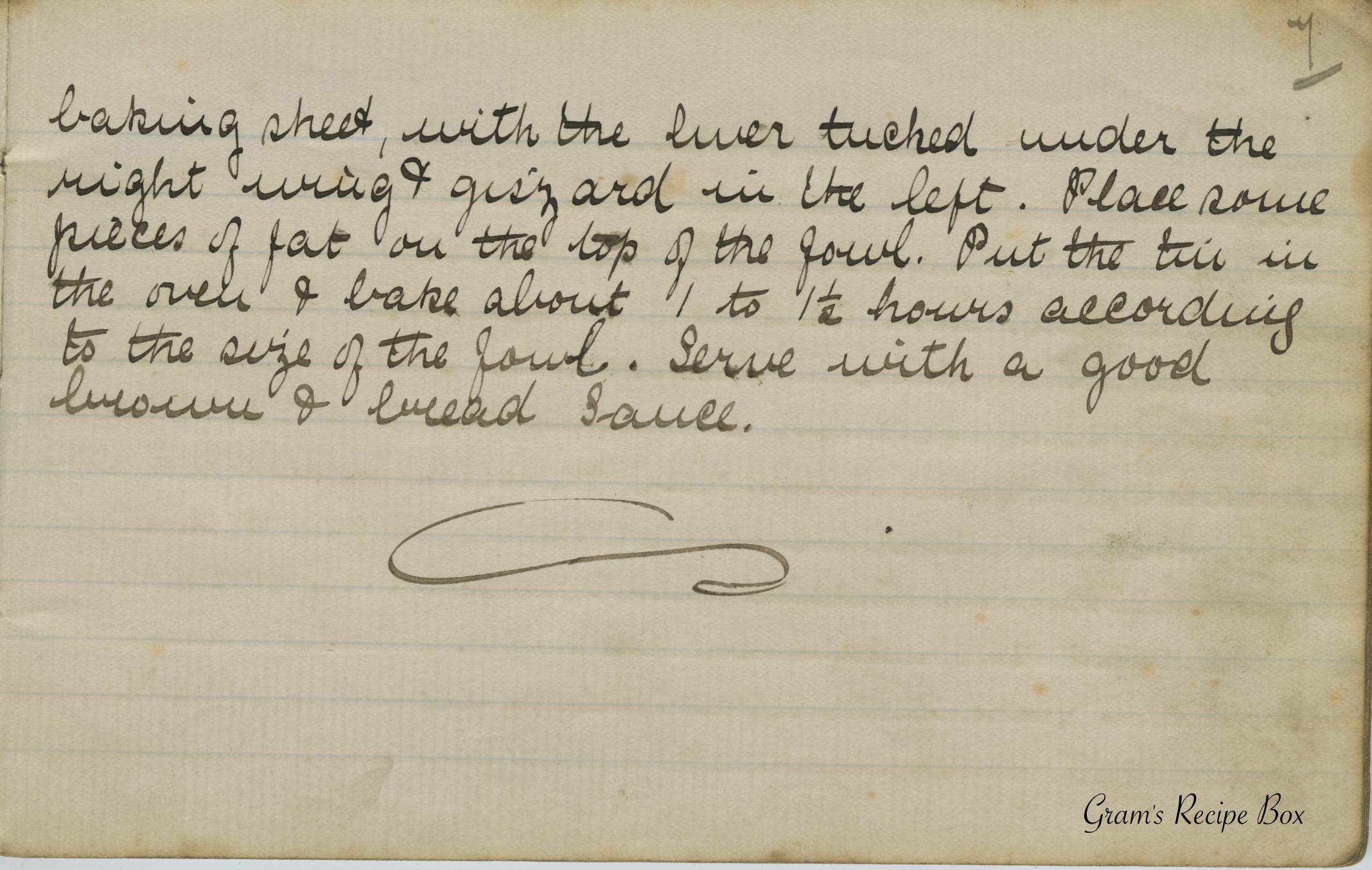
First cut the head off where the neck is broken. Turn the fowl on its breast, catch hold of the neck with a piece of paper & cut down the skin about two inches. Loosen everything from the neck & cut it off. Put your four [sic] finger and thumb into the crop & loosen all the skin from it then pass the finger through the body and break the skin right round. Take nothing away, make a small cut across the vent. Press from the breast downward through the vent, when everything ought to come clean away. Remember when you are taking away the gall bladder not to break it. Cut the feet off & hold them in boiling water for a minute or two to remove the ruff [sic] skin. Wipe the inside of the fowl out with a cloth & if there are any hairs on it singe them by lighting a piece of paper. Take both the wings in your hands & turn them back. Turn the fowl on its back, take hold of the right wing. Run a trussing needle through it & shove up the left leg. Pass the needle through it & left wing. Turn the fowl on its breast & tie a knot. Again shove up the right leg, pass the needle over it, over the left leg, also at the lower joint & tie it. Place the fowl on a well greased baking sheet with the liver tucked under the right wing & gizzard in the left. Place some pieces of fat on the top of the fowl. Put the tin in the oven and bake about 1 to 1 1/2 hours according to the size of the fowl. Serve with a good brown & bread sauce.