Catherine Soup is good

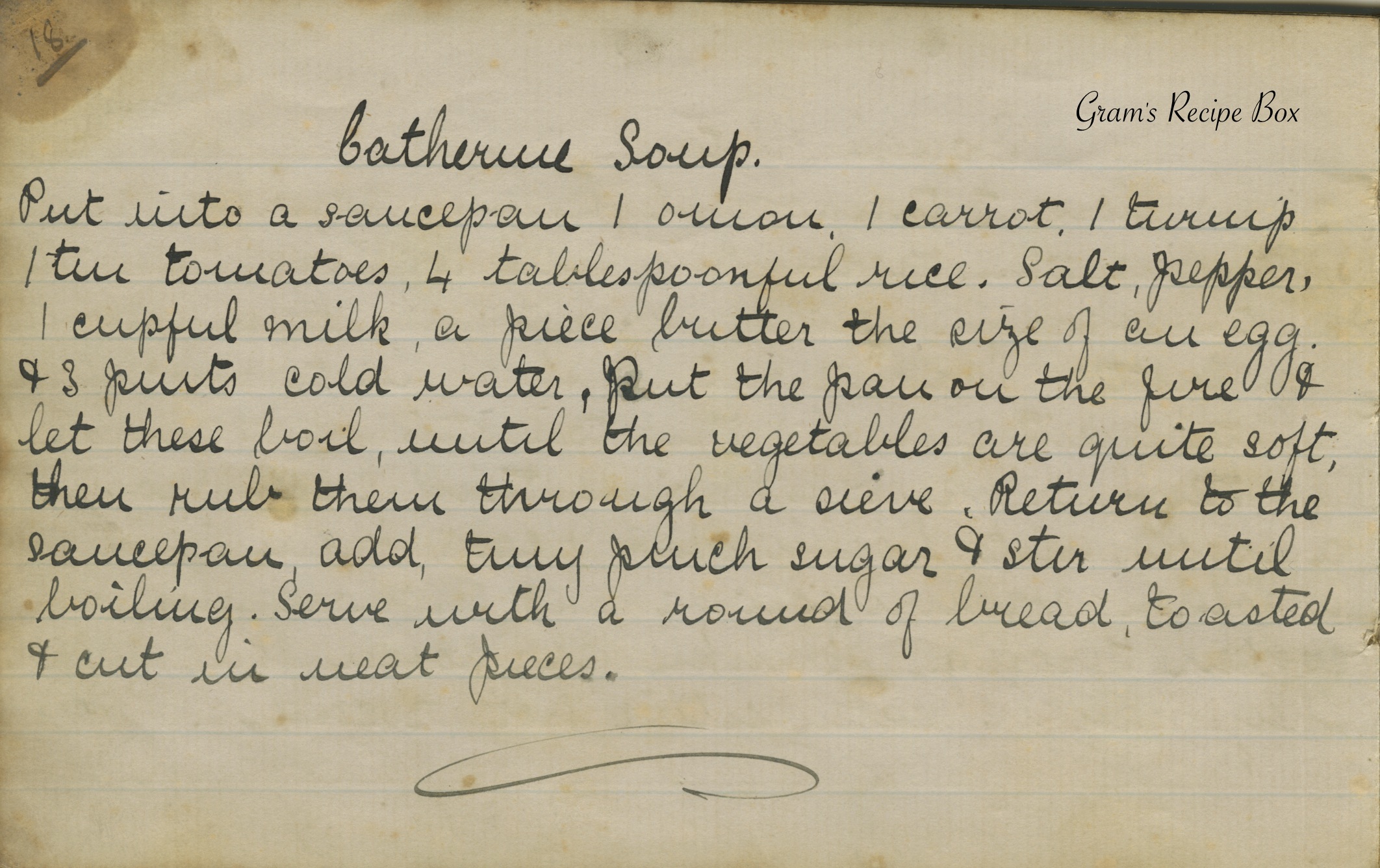
I have been in a soup mood, so I decided tonight to make the Catherine Soup recipe which I posted just a few days ago. I ensured that I had all the ingredients and went to work. Since my onion was rather large and strong, I only used half. I diced it in small pieces, as well as the turnip. I have only baby carrots on hand since they are easier for little fingers to handle, and I used about 6 of those, diced. These all went into the pot with the 6 cups water, 1 can tomatoes, butter, and milk. I used 5 tablespoons of rice instead of 4, because 4 didn’t look like all that much. I added fresh ground pepper and about a teaspoon of salt.

This I brought to a boil, then reduced to a simmer. I covered the kettle but in future I wouldn’t do that again because it seemed to need to vent. I let it simmer for an hour or so. I had plenty of time so wasn’t in any sort of a rush. After it had simmered and the vegetables were quite soft, I ran it through the blender. Before blending, it was a lot like a broth with chunks of tomato in it. After blending it was a nice smooth red-orange color. I forgot to add the pinch of sugar, but I did add some garlic because it seemed a little demure to me.
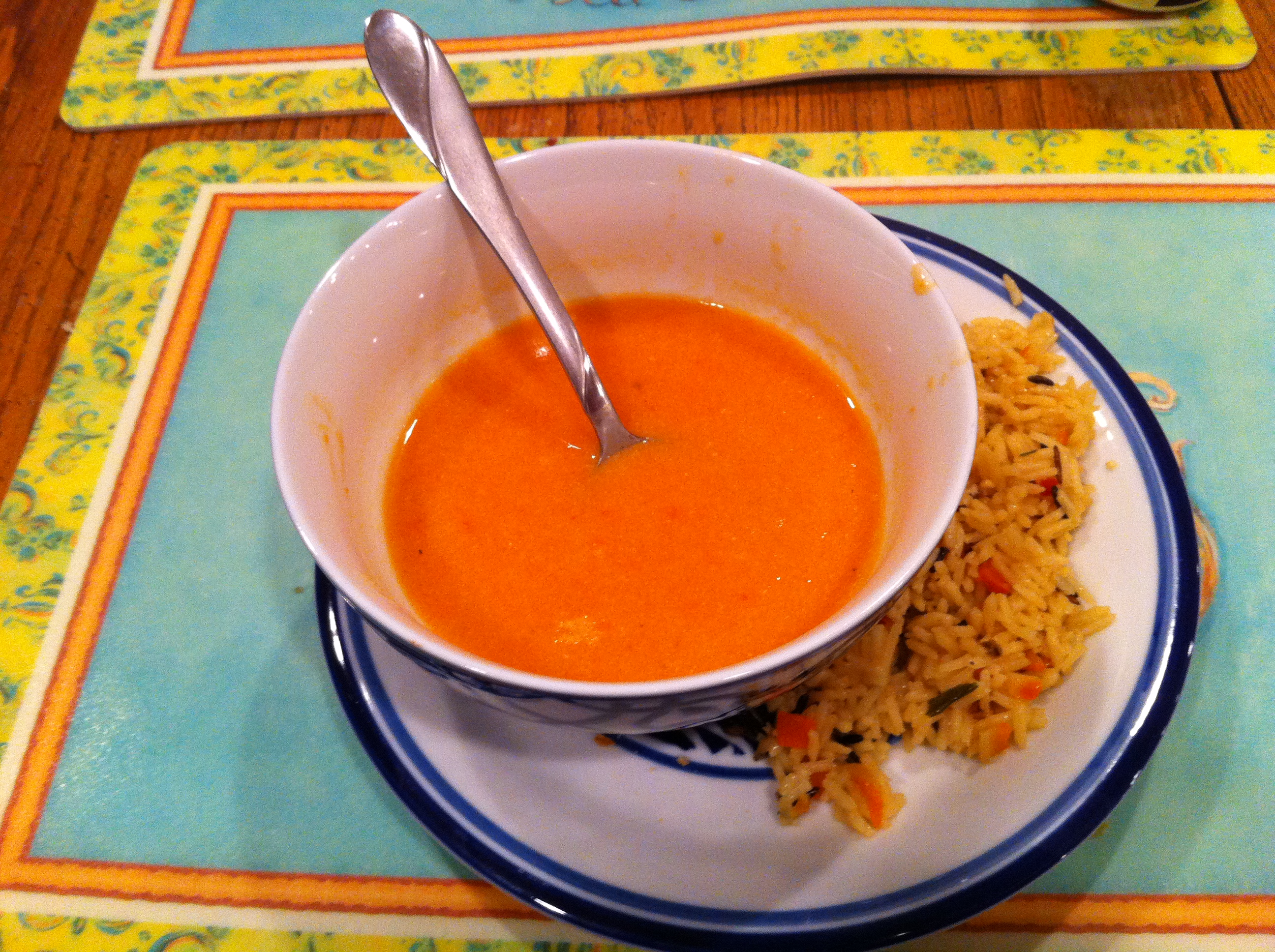
Catherine Soup and rice for dinner

I toasted slices of bread and had a side dish of basmati rice just in case we didn’t like the soup, but it was quite delicious. Perhaps because I used more carrots than necessary, it leaned toward a carrot soup taste, but I could also taste the other flavors. It was rich and delicious, and might be enhanced with flavored croutons on top.

Next up will be Gravy Soup because it sounds so yummy.

Gravy Soup

Although this is called gravy soup, I do wonder if it is more like stew. I assume where she says to “prepare a carrot…” etc that she means to chop or slice the vegetables and to finely chop the herbs. Also, she’s left out a word where it says “…a few cloves…” and I take it that this should be garlic.

UPDATE: I stand corrected, she didn’t leave out any words. She probably intended the spice clove to be used. 

Gravy Soup

Take 1 lb lean fresh beef, cut it up into small pieces free from fat. Put into a saucepan a piece of butter the size of a walnut, make it quite hot. Throw the beef into the pan & with a spoon press it & move it about for 5 or 6 minutes. Put the lid on the pan & allow it to sweat for 3 or 4 minutes. Then prepare a piece of carrot, a piece of turnip, an onion, a blade of mace, a few cloves, a few peppercorns, a sprig of parsley, thyme & celery. Add these to the beef & allow them all to sweat for 5 minutes longer. Then add slowly 8 pints hot water. Let the  soup simmer slowly for about 1 1/2 hours. Strain it & skim off any fat that may come to the top.

Gingerbread

This recipe is a bit confusing because we don’t think or measure or even use some of these ingredients anymore! First and foremost, treacle. What exactly is this stuff? You might have heard some snarky society commentator complaining that “so and so is spewing utter treacle and it’s nauseating” or the like. Treacle is a sugar syrup and is the product of the sugar cane refining process. It is still in use in Britain under the name dark treacle. The closest similar item you will quickly recognize is molasses, also a product of the sugar refining process, yet one is obtained in a different way than the other. I found Recipes4Us has the Reader’s Digest version on treacle so click over there for more detail. For our purposes today, you may use molasses, but do know that there is clear treacle and dark treacle. Dark treacle is similar to black strap molasses and will give you a stronger flavor. If you wanted to try a clear treacle substitute, you could try light Karo. Unfortunately, the recipe above does not specify which type of treacle was to be used, though I suspect it is dark treacle (in which case just use molasses).

Secondly, this business of weighing your saucepan. When Maggie Ritchey was writing this recipe in class, she did not have the ability to take the “tare weight” of the container, meaning she couldn’t just pour out 1/2 a pound of treacle; it had to go into something and that something had a weight as well, so she calculated the weight of her saucepan plus 1/2 a pound, took out the weight, then poured her 1/2 pound of treacle. Today’s modern scales will weigh your container and then balance the scale to zero, effectively setting the scale to a negative weight. What does this mean in 21st century measurements? You will be using somewhere around 8 ounces of treacle or molasses. Use a scale to weigh your measuring cup, hit the tare button, then start pouring until your scale reaches 1/2 pound. Normally I would calculate this for you but my scale broke and I’ve yet to replace it.

This gingerbread recipe does not sound like the sweet and spicy gingerbread our modern palate is accustomed to – it uses cayenne pepper and caraway seeds, probably giving it a kick back that is a savory and pleasant finish after the sweetness of the treacle and sugar.

Gingerbread

Take the weight of a saucepan, add 1/2 lb weight. Pour into the saucepan 1/2 lb treacle. Take the saucepan off the scales & weight 1/4 lb lard. Add this to the treacle. 1/2 lb sugar 1/2 teacupful water. Put the pan on the fire & let these melt. Put into a basin 1 lb flour 1/2 teaspoonful salt 1/2 teaspoonful ground ginger 1/2 teaspoonful ground cinnamon, a pinch of allspice 1/2 teaspoonful carbonic of soda, a pinch of cayenne pepper, a tablespoonful carraway seeds. Mix these all well together. Drop in 2 whole eggs, with the melted treacle, lard & water. Beat very thoroughly. Place in a greased baking sheet & bake in a slow oven for 1 hour. The addition of some blanched, chopped almonds will be an improvement to those who like them.

Victoria Buns

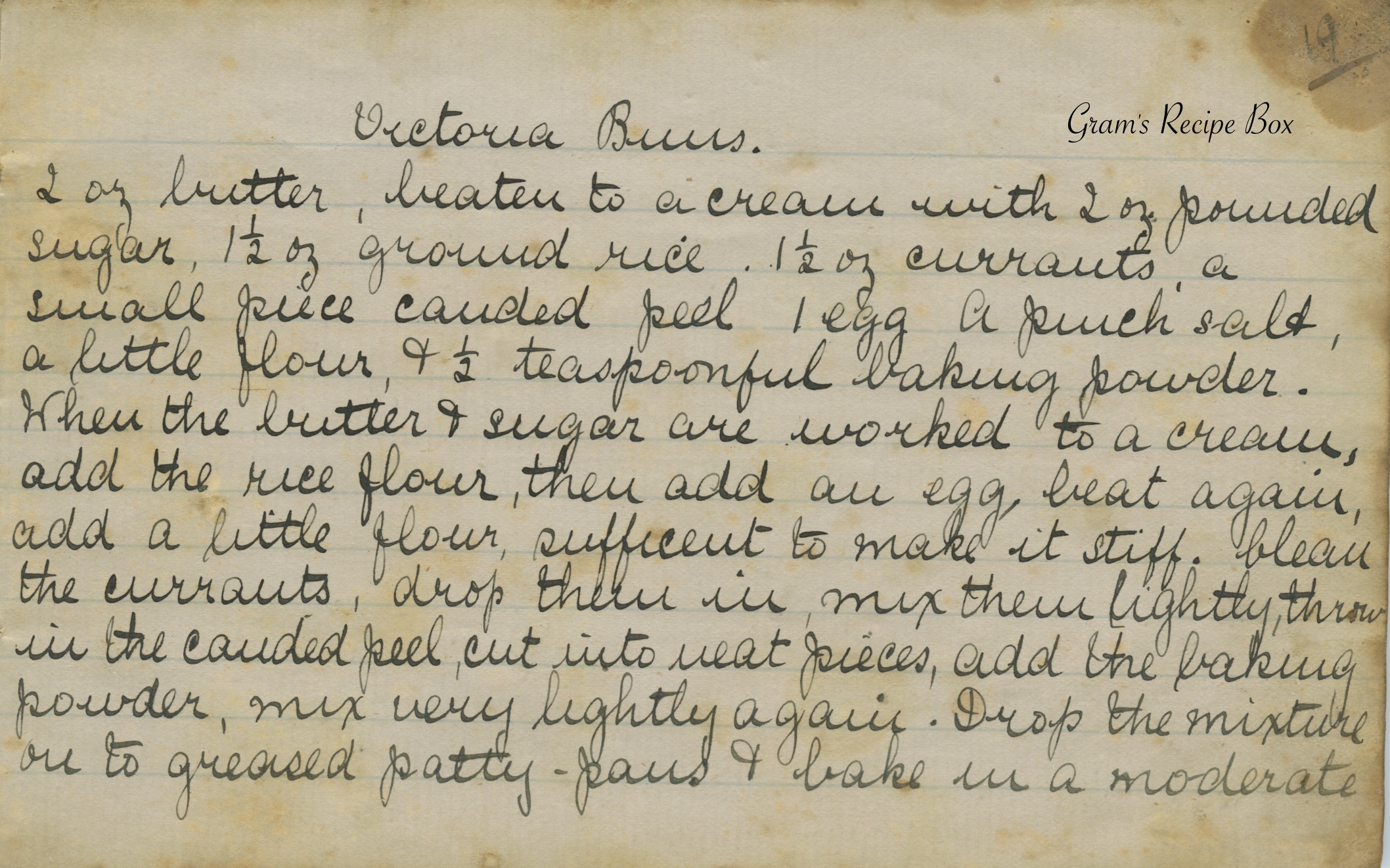
I found three references to Victoria Buns online, from 1861, 1880 and 1885. In 1861, the recipe for Victoria Buns was almost the same as this one, and was found in a household book for women. Vintage Recipes has this book available for you to peruse in a transcribed format, as well as many other heirloom recipes. 1880 brought us a book called Tasty Dishes with loads of old advertising that is worth clicking over in itself, and the recipe remains similar to this one. The last reference to Victoria Buns was from a Creole cookbook from 1885 and sounds nothing like Maggie Ritchey’s recipe, but you can’t help but browse through just for the sake of looking. I believe these might have been made as tea biscuits.

Victoria Buns

2 oz butter, beaten to a cream with 2 oz pounded sugar, 1 1/2 oz ground rice, 1 1/2 oz currants, a small piece candied peel, 1 egg, a pinch salt, a little flour & 1/2 teaspoonful baking powder. When the butter & sugar are worked to a cream, add the rice flour, then add an egg, beat again, add a little flour sufficient to make it stiff. Clean the currants, drop them in, mix them lightly, throw in the candied peel cut into neat pieces, add the baking powder, mix very lightly again. Drop the mixture on to greased patty-pans & bake in a moderate oven. Sometimes the mixture is made so stiff by flour that it is rolled up into balls & baked on a tin. Bake until firm & a nice brown colour.

Catherine Soup

I can’t find any historical references to Catherine Soup so this could very well be the soup devised by the home economics teacher. It sounds an awful lot like a homemade tomato soup or vegetable puree. This could be good as a winter lunch soup, as it sounds hearty and sustaining, while also warming the body. As to the ingredients, I have no idea how much a tin of tomatoes contained, so try 1 medium tomato. Also, cut the vegetables into smaller pieces so they will cook through more quickly! Finally, feel free to run this through your blender once the vegetables are soft rather than smashing them through a sieve.

Catherine Soup

Put into a saucepan 1 onion, 1 carrot, 1 turnip, 1 tin tomatoes, 4 tablespoonful rice, salt, pepper, 1 cupful milk, a piece butter the size of an egg & 3 pints cold water. Put the pan on the fire & let these boil until the vegetables are quite soft, then rub them through a sieve. Return to the saucepan, add tiny pinch sugar & stir until boiling. Serve with a round of bread toasted & cut in neat pieces.