Rabbit Pie

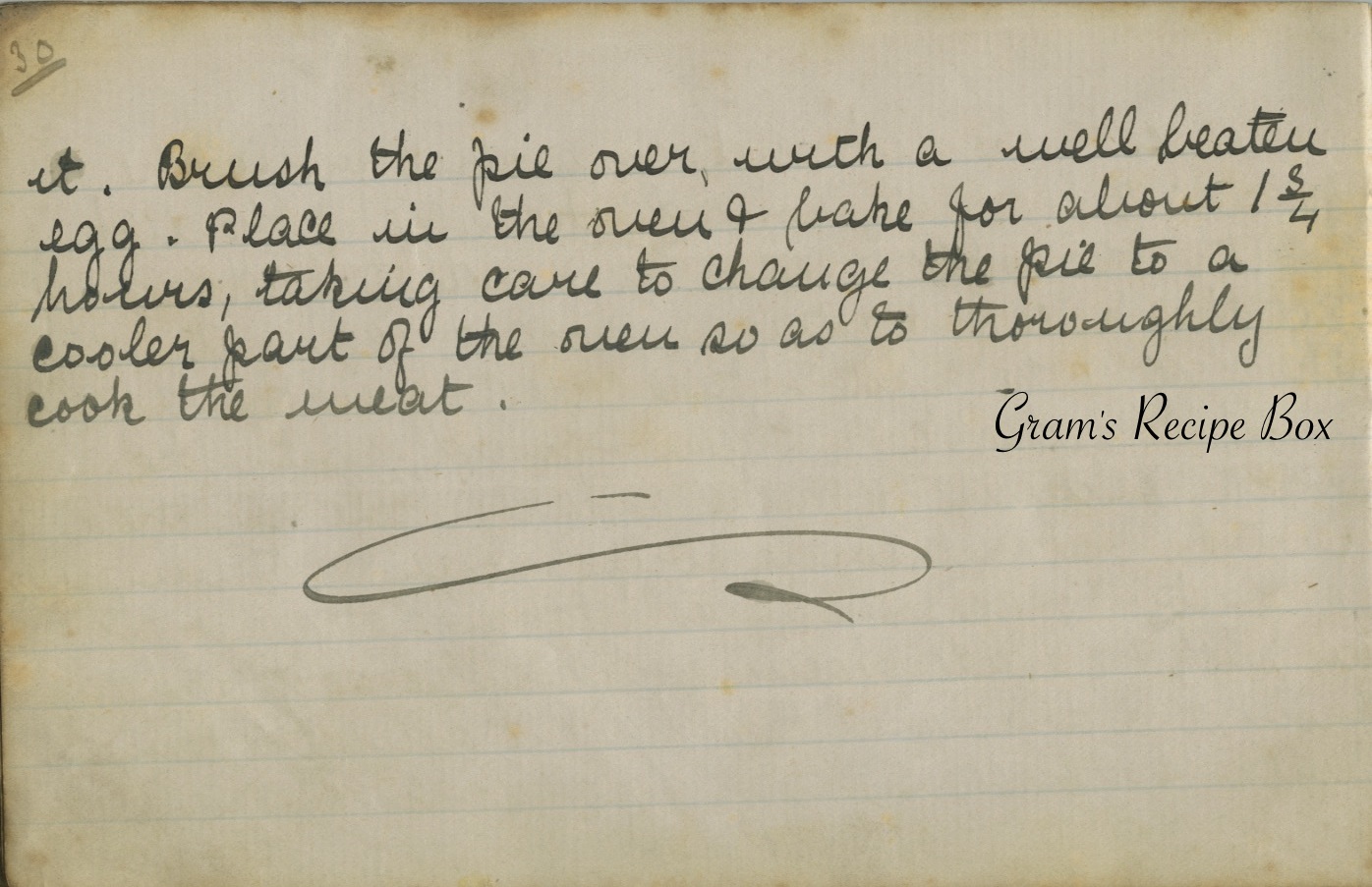
Sometimes when you try to describe how to do something, it just doesn’t translate well and the action must be seen to be understood. That is where I am with the description Maggie gives us of how to place the pie crust over this meat pie and further with the leaves. Hopefully it made sense to her and she was able to duplicate the pie to great success in her own kitchen. Recently, we started watching Downton Abbey and I do so wonder if Maggie Ritchey was training to work in a kitchen such as that – large with many layers of staff and propriety – or if she was just learning home economics for a large family. I will never know.

Rabbit Pie

Take a rabbit, cut it up into neat joints & wipe the joints. Lay some of these into a pie dish. Sprinkle over these some pepper & salt, a little chopped parsley, then some very thin slices of bacon rolled, some more rabbit & so on until the dish is full. A squeeze of lemon juice & a tiny grate of nutmeg, enough cold water or stock to fill the dish. If light, a couple of hard boiled eggs cut in quarters may be added. Roll out the pastry, to about 1/2 an inch in thickness & turn it so as to get it to a square. Wet round the edges of the dish, cut off a strip from the pastry & lay it round the edge of the dish with the rough edge in & well lapped across. Wet this piece of pastry all round & cover it with the rest of the paste & take care to press the edges well together. Nick them round with the back of a knife & make a large hole in the centre, cut out some strips from the trimmings of pastry & make some leaves by taking a straight strip an inch & 1/2 wide, placing your knife across it & taking from it a diamond, then mark it down the centre, with the back of a knife, so  as to vein it. Brush the pie over with a well beaten egg. Place in the oven & bake for about 1 3/4 hours, taking care to change the pie to a cooler part of the oven so as to thoroughly cook the meat.

Rough Puff Pastry

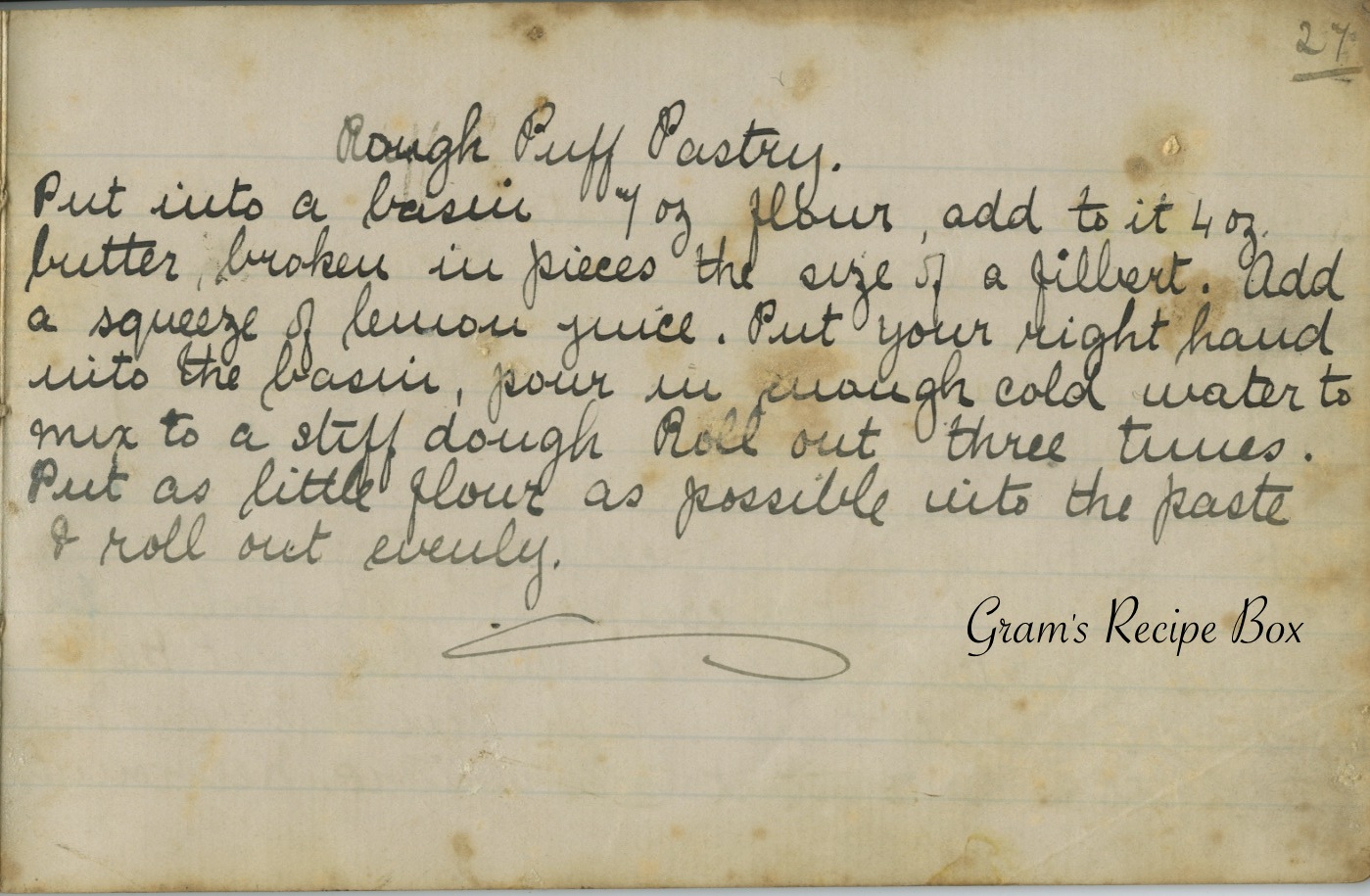
I am not much with pie doughs, rolled cookies or anything that requires the right balance of flour to make it not too dry but just dry enough to roll. My doughs always wind up being too sticky or dry and then I lose patience. There are many puff pastry recipes out there, all of them more detailed than Maggie’s recipe pictured above. If you have never made puff pastry, I recommend reading a few other recipes before trying this one. There apparently is a technique to rolling and chilling the dough that could make or break your pastry.

Most of the recipes I read have the dough chilled in between rolling, so where it is noted “roll out three times” you will need to refrigerate in between for about 20 minutes.

Rough Puff Pastry

Put into a basin 7 oz flour, add to it 4 oz butter broken in pieces the size of a filbert. Add a squeeze of lemon juice. Put your right hand into the basin, pour in enough cold water to mix to a stiff dough. Roll out three times. Put as little flour as possible into the paste and roll out evenly.

Rissoles of Cold Meat

This recipe had me heading to the internet to find out exactly what a “rissole” is. I have heard the term, but never really been aware of it, so it was about time I found out, right? The dictionary tells us that a rissole is “A small, pastry-enclosed croquette of a minced meat or fish, usually fried in deep fat.” Okay, what is a croquette? “A small cake of minced food, such as poultry, vegetables, or fish, that is usually coated with bread crumbs and fried in deep fat.”

This makes it sound like a chicken nugget wrapped in pastry dough and deep fried. Somehow I don’t think that is exactly correct. Depending on where you live, a rissole may be as simple as a burger patty or as involved as wrapping the patty in philo dough. Rissoles are apparently very popular in Australia and New Zealand, called RSL or r-sole by locals, and maybe even popular in England and sold in chip shops, though I can’t believe everything I read online.

Essentially, meat, fish, or poultry can be used as the meat base. Ground or minced finely, it will be seasoned and then either breaded with bread crumbs or wrapped in dough, then fried. In some recipes, the breadcrumbs are worked into the meat mixture and the rissoles are cooked without the fat, even over a barbeque. The rissole can make up the main entree of the meal or simply be a part of it. This particular recipe seems like it might need to be kicked up a notch, maybe with some spices or even finely chopped onion or other veggies.

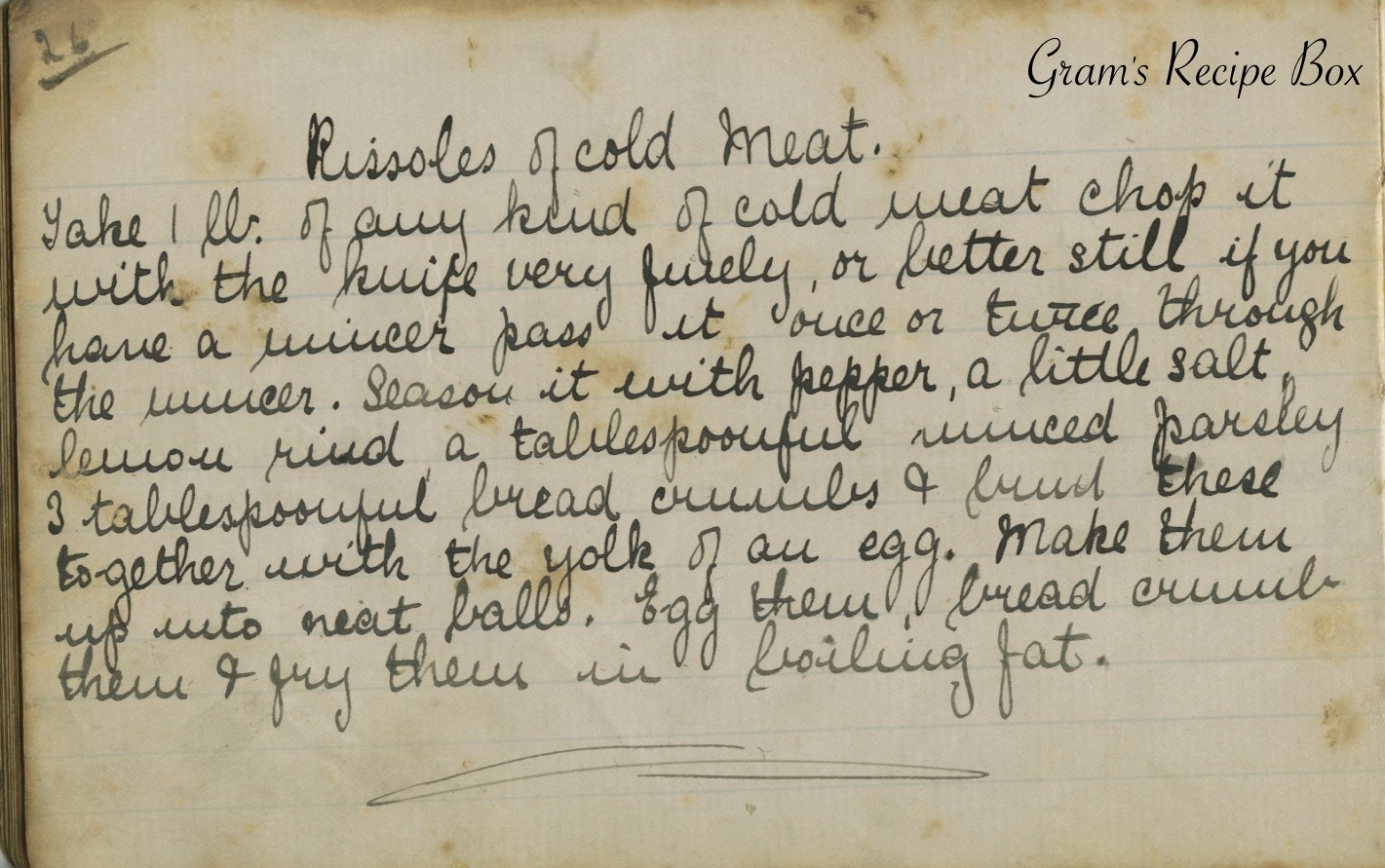
Rissoles of Cold Meat

Take 1 lb of any kind of cold meat, chop it with the knife very finely, or better still if you have a mincer pass it once or twice through the mincer. Season it with pepper, a little salt, lemon rind a tablespoonful minced parsley 4 tablespoonful bread crumbs & bind these together with the yolk of an egg. Make them up into neat balls. Egg them, bread crumb them & fry them in boiling fat.

Gravy Soup, not very gravy-like

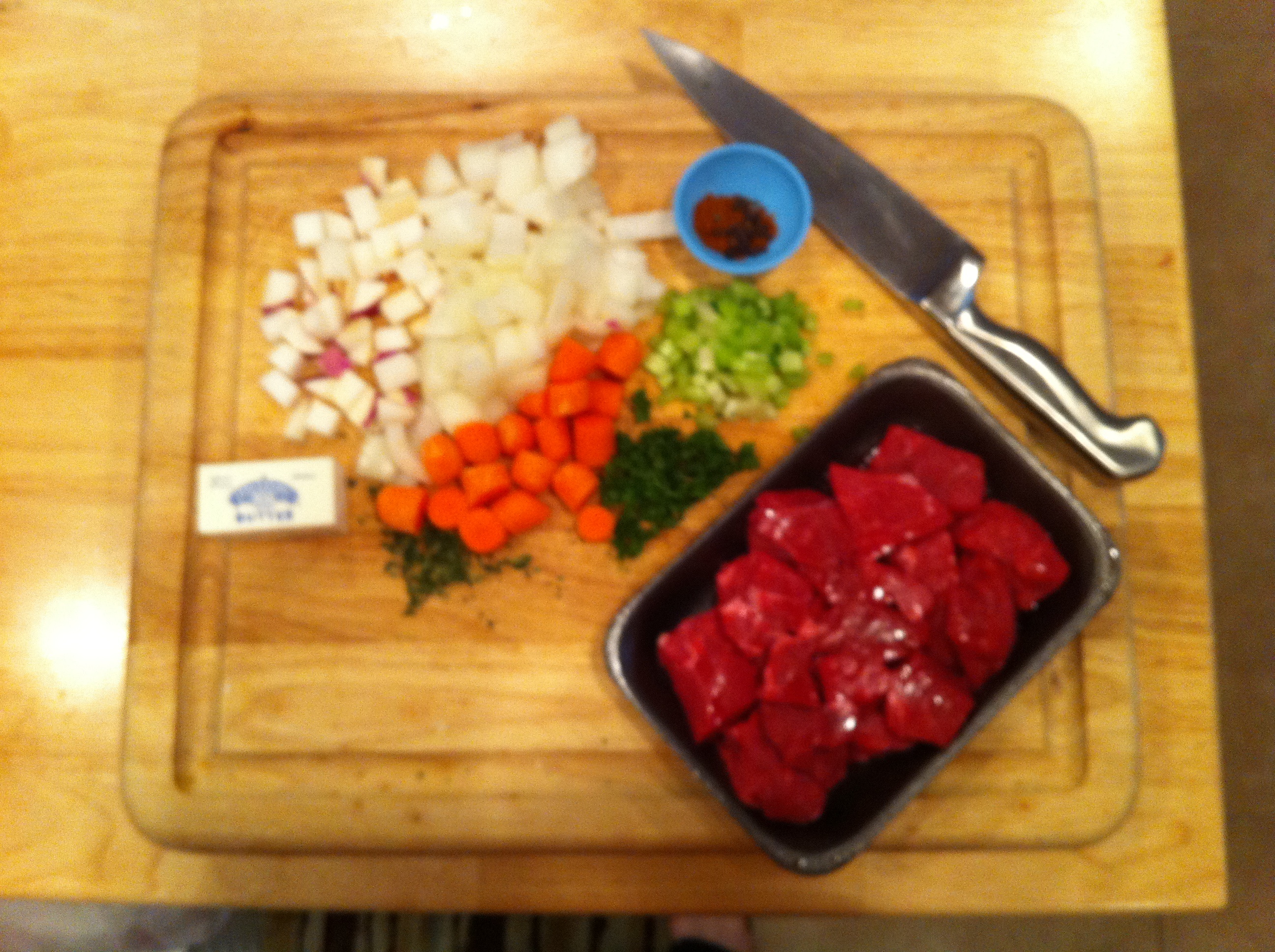
Still being in my soup mood, I thought it would be nice to try Gravy Soup, which was posted a few recipes back. Considering the name, I thought this would be a thicker, gravy or stew like soup. With this in mind, I set out my ingredients.

Ready to cook

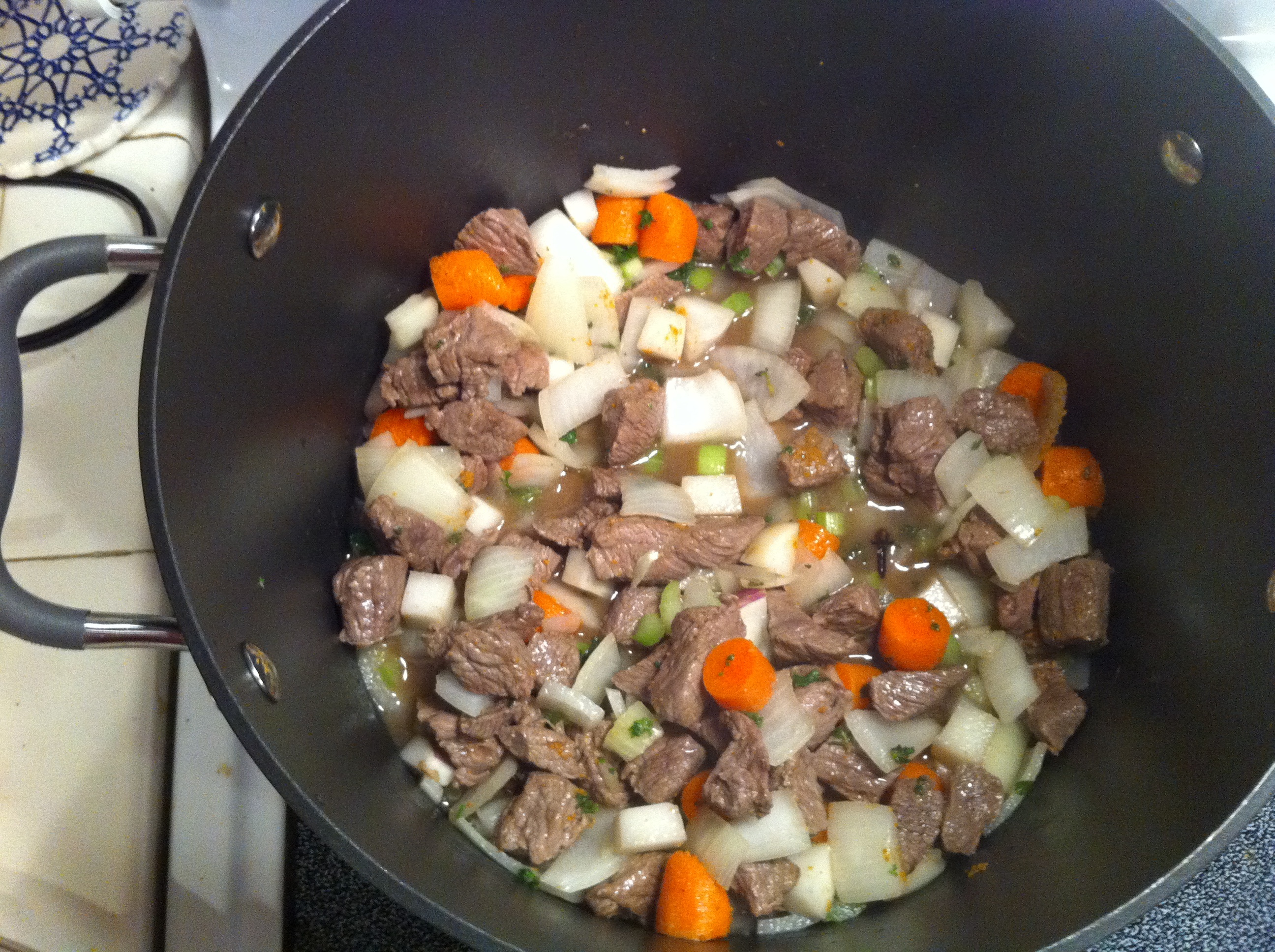
I hope you will forgive the image quality here, but I was using my iPhone instead of my regular camera because the battery was not charged. After all this chopping I also cut the meat into bite sized pieces, and then put it into the stew pot once the butter was melted. Following the instructions, I let the meat brown for about 5 minutes, then added the vegetables and herbs & spices.

Starting to smell good

This really was starting to smell good at this point. The mace is an interesting smelling spice. It is the outer husk of the nutmeg and the individual pieces are called blades once dried. I imagine that Maggie Ritchie actually would have ground it fresh, which is time consuming since it is somewhat of a woody type of item apparently. It has a bit of a nutmeg odor with a savory touch. Having never cooked with nutmeg outside a baking project, mace in with the other ingredients was an unusual combination to my nose. However, I figured I’d give it a shot.

Quite liquid-y

Once I added the 8 pints of water (16 cups) I knew this was not going to be a stew like dish. Again, going with it, I left the lid off, brought it up to a boil then took it down to a simmer and let it go for 1 1/2 hours. Finally it was time for dinner and I knew this was going to be a “now or never” moment. I tried the soup. It was very bland. It smelled nice, but upon tasting the broth was thin and rather tasteless. I think if I were to make this again I’d cut the water in half, at a minimum. It seems like just too much water for so small a volume of flavorful ingredients. Being as I could not leave well enough alone, I added some beef bouillon, garlic powder, salt & pepper. And dumplings.

Soup's on!

With the dumplings the broth thickened a little bit but it was still quite like a broth soup rather than a stew. I would have much preferred stew and so perhaps in future I will make this general idea of the soup beginning, then diverge at the quantity of broth. Should you like to try this dish, I suggest cooking to your taste as you go along.

Stewed Fruit

This recipe would be more accurately titled “stewed prunes” but that isn’t the way Miss Ritchie wrote it way back when. Prunes as we know them today are the dried type, or even the stewed type, but really they are small plums, and when prepared fresh this would probably be a nice dessert. If you can’t find fresh prunes in your local grocery (you can’t I have looked) you might be able to find them at a green grocer or farmer’s market where plums are sold. Speak to the seller to find out if they have prunes or small plums available.

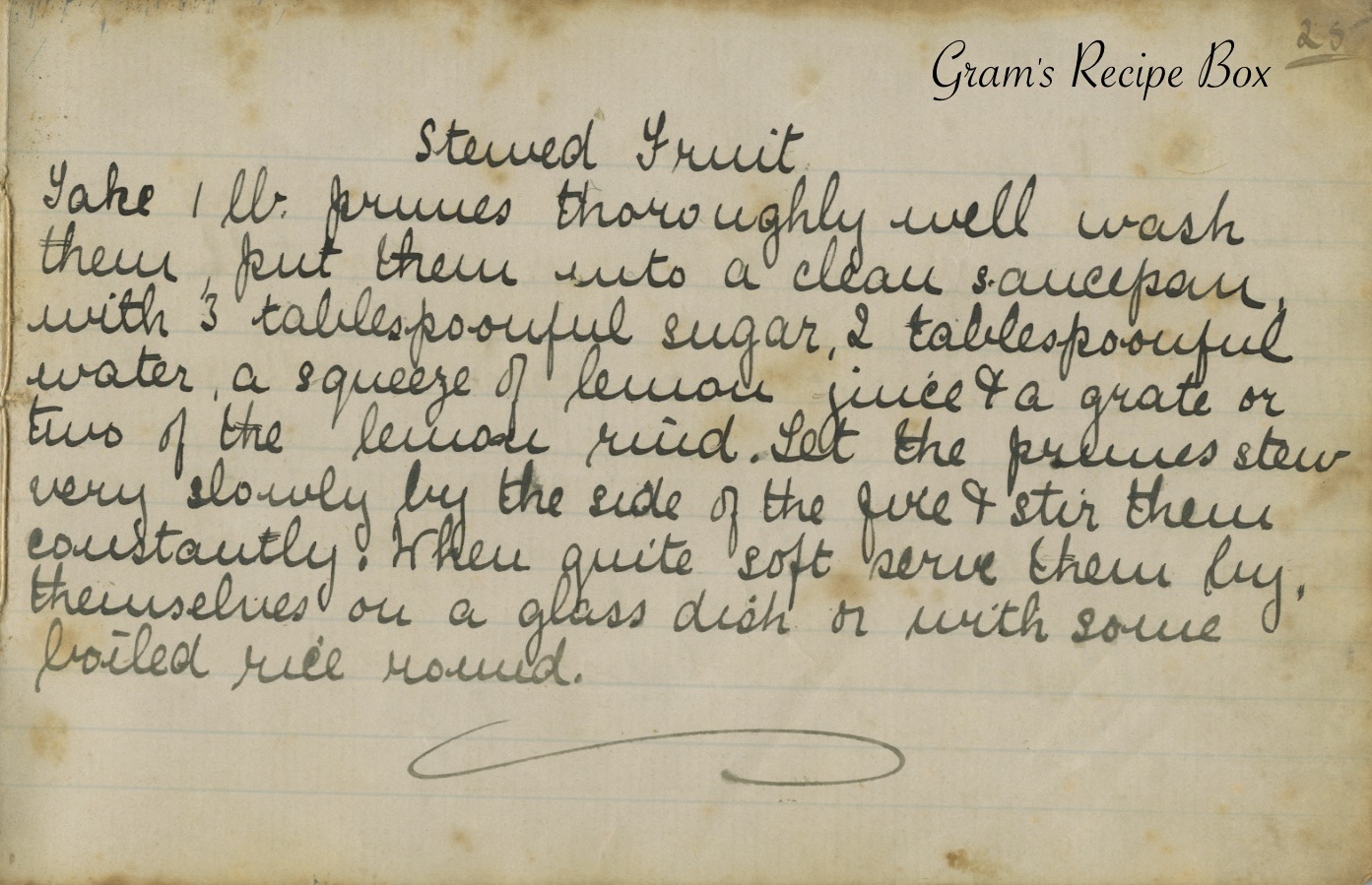
Stewed Fruit

Take 1 lb prunes thoroughly well wash them, put them into a clean saucepan, with 3 tablespoonsful of sugar, 2 tablespoonful water, a squeeze of lemon juice & a grate or two of the lemon rind. Let the prunes stew very slowly by the side of the fire & stir them constantly. When quite soft serve them by themselves on a glass dish or with some boiled rice round.