Dough Nuts

There are numerous recipes for dough nuts/donuts/doughnuts and the name always makes me wonder if they were originally called dough knots. I haven’t found any evidence of such naming, it just makes sense to me.

I have noticed that Maggie frequently directs to “rub in” the butter. I can only surmise this was how it was done in the days before the electric mixer. You could probably use a pastry cutter or even your fingers. I myself will use the mixer on low.

Dough Nuts

1/2 lb flour 1/2 teaspoonful baking powder, pinch salt, mix these thoroughly well together, then add a tablespoonful sugar, mix again, then rub in 1 oz butter, lard or fat. Fat is best, rub it in until quite small. Mix to a stiff batter with butter-milk. Drop some tiny pieces from a spoon into boiling fat & cook them until a golden brown colour, yet thoroughly cooked through. Sprinkle over some fine sugar. They may be eaten either hot or cold.

P.S. I promise to be more diligent at updating this site. It has fallen by the wayside and yet I have so much source material to work with! Just today I scanned well over 50 recipes, so look forward to more frequent updates, and hopefully back to daily soon!

Fish Cakes

Fish cakes can be served with basic tartar sauce or more fancy aioli sauce, kept simple to preserve the flavor of the fish or jazzed up with Parmesan cheese and garlic. The choice is yours. This recipe from Maggie Ritchie give a good base for fish cakes that is still followed today in upscale kitchens across America. Make it with salmon and add a mango salsa for something interesting, try it with cod and top with a tangy chutney. Whatever sounds good to you, that’s the beauty of cooking at home!

A note, Maggie has written “equal quantities of cold mashed potato.” What she means here is to use the same volume of potatoes as you do of fish. Also, rather than using boiling fat, try using canola oil. Olive oil would also be fine but if you take it to too high of a temperature it can smoke.

Fish Cakes

Take any cold fish that may be in the house, free it from the bone with two forks. Put it into a basin, add to it a pinch salt and a pinch cayenne pepper & equal quantities of cold mashed potato. Bind with an egg, mix these together with a spoon & take a little of the mixture on to a floured board. Shape it with the back of a knife into flat cakes, then dip them into a beaten egg & bread crumbs. Fry them in boiling fat.

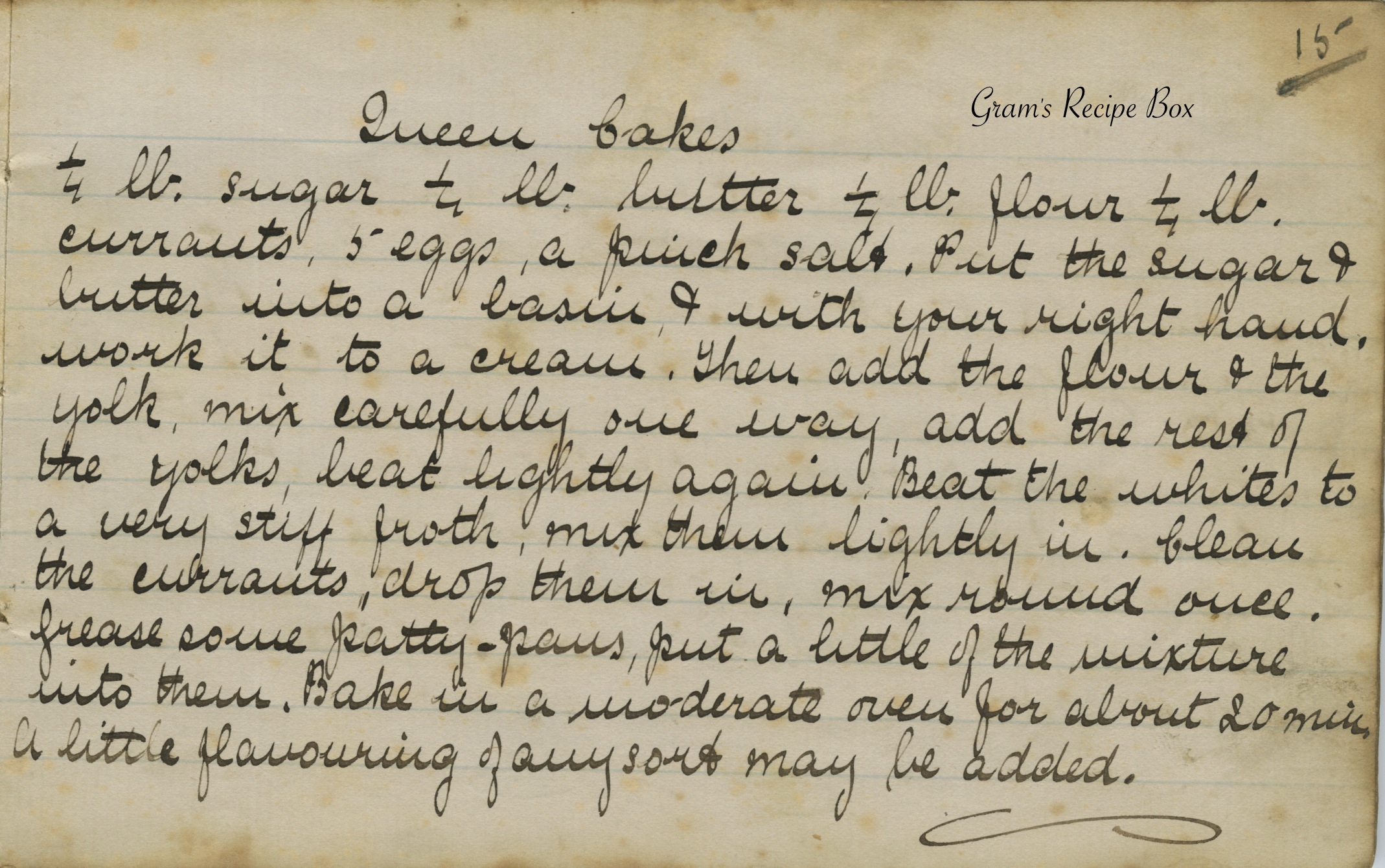
Queen Cakes


Queen cakes are a very early form of cup cake! So for all you cup cake enthusiasts out there who happen to like history, this recipe is very similar to one dating back to the 1600s. According to the Researching Food History blog, various royal chefs wrote cookbooks, with names like The Queen’s Royal Cookery and The Queen’s Closet Opened and often included recipes named for certain people, including the Queen. These little pound cakes are made in what we now call muffin tins, but at the time were called patty pans (and in some parts of the world this term in still in use). You can also bake them in crockery, cups, and small bowls that can withstand the heat of the oven. I found several years ago those cute little tins you might make madelines or a little tart in, at an upscale cooking shop, and now I know just what I will be making in them! Early Queen cakes could be iced in the method which baked the icing onto the cake, much like Martha Washington’s Great Cake, meaning, the icing was spread all over the cake, then the cake returned to the oven at a low heat and essentially dried onto the cake. The icing could be flavored with orange water or rose water, something our modern palate might not appreciate. I expect I’d use a simple vanilla icing.

Queen Cakes

1/4 lb sugar, 1/4 lb butter, 1/4 lb flour, 1/4 lb currants, 5 eggs, a pinch salt. Put the sugar & butter into a basin & with your right hand work it to a cream. Then add the flour & the yolk, mix carefully one way, add the rest of the yolks, beat lightly again. Beat the whites to a very stiff froth. Mix them lightly in. Clean the currants, drop them in, mix round once. Grease some patty-pans, put a little of the mixture into them. Bake in a moderate oven for about 20 min. A little flavouring of any sort may be added.

Rice or Semolina Pudding

You might not think you know what semolina is, but I bet you do. Once a wheat grain has been through the mill, there are essentially three parts – the bran, the germ and the center, known as the endosperm. I’ll just call it the center if that’s okay with you. When the wheat you are using is of the durum variety, this center is called semolina, and can be ground more finely into flour. When you use many varieties of wheat, this center is called farina, and in America we have the brand Cream of Wheat. Semolina and farina are used in pasta making as well. This recipe is for either rice or semolina pudding. I’m not a big fan of rice pudding myself, but it is a great gluten free dessert for those who need or want it.

Rice or Semolina Pudding

Put into a basin 2 tablespoonful of rice or semolina, well wash it, put it into a clean saucepan with plenty of water & boil it until soft. Pour the water from it, grease a pie dish. Put the rice into it & fill up the dish with milk & stir in with a fork a well beaten egg. Put in a tablespoonful sugar & a little flavouring, beat it all well to-gether in the dish. Grate a little nutmeg over the top. Place in a moderate oven & bake until firm to the touch & a nice golden brown colour.

Scones

If you have been looking for a traditional scone recipe, here it is. Honestly, scones can be difficult to make, but when you consider this very old method is quite straight forward, then maybe it’s just that making scones from scratch is intimidating, but not actually difficult. These scones would be more like a biscuit, so you may want to try adding raisins or currants, orange zest and cranberries, cinnamon or lemon zest for variety. Note, carbonic of soda here refers to baking soda. Also, she references “enough butter milk” which I think could simply mean “make it damp but not soggy.”

Scones

Put into a basin 1 lb flour, teaspoonful salt, 1/2 teaspoonful cream of tartar, 1/2 teaspoonful carbonic of soda & mix these thoroughly well with the tips of your fingers, until quite free from lumps. Then rub in  oz butter & mix with your right hand to a soft wet dough, with enough butter milk. Grease a baking tin. Shape the scone round, mark it in four. Lay it onto a baking sheet & bake it in a quick oven for about 20 to 25 minutes.